
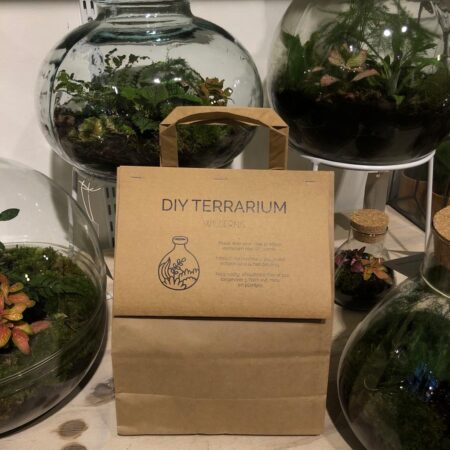
Make your own terrarium
Make your own terrarium: Step by step
A closed terrarium is a mini-ecosystem: water vapor from the plants condenses and drips back into the ground along the glass. Withered leaves fall to the bottom and are converted into food for the plants. Plants in a closed bottle can live for years.
What do you need to make a terrarium?
- Wildernis terrarium package (hydro pellets, potting soil, activated carbon)
- Moss (usually available at Wildernis)
- 1 bottle of about 5 liters (also available at Wildernis). A weck jar is also possible. As long as you can close the jar or bottle and the opening is not too small, remember everything has to go in through the neck.
Use small plants and do not put too many plants, leave them some space to grow.
Suitable species are: Fittonia, ferns such as zinc fern (Phlebodium) or maidenhair (Adiantum), Calathea, grass lily (Chlorophytum),
ivy (Hedera), spoon plant (Spathiphyllum), leaf begonia (Begonia rex), Hypoestes phyllostachya and Philodendron scandens.
Which plants are suitable for a closed terrarium?
Choose small plants that enjoy a humid environment, such as Fittonia and small ferns. Also consider how large they will eventually grow. Cacti and succulents are better suited to an open terrarium.
Additional supplies (tools) for a bottle with a small opening:
- Sturdy tape and an A4 sheet
- An empty PET bottle, of which you use the cap with a piece of neck as a funnel
- Thin (bamboo) sticks of about 40 cm
- 2 teaspoons and a cork from a wine bottle
- Piece of sanding sponge
Step 1: Clean the bottle
Clean the bottle thoroughly with hot water and green soap. Is the inside dirty and do you have a small opening? Make tools from a piece of scouring pad that you attach to a bamboo stick with a rubber band. Rinse the bottle well and let it dry.
Step 2: Add the clay pebbles
Put the hydro granules in the bottle. This first layer ensures that the roots do not sit in standing water. Do you have a small opening? Then make a long funnel from the top of the PET bottle and a rolled-up A4 sheet far into the bottle, so that you can neatly get the hydro granules, charcoal and potting soil into the bottle.
Step 3: Add the activated carbon
Spread the activated carbon evenly over the layer of hydro granules. Activated carbon provides purification and counteracts fungi.
Step 4: Add potting soil, plants and moss
Apply a layer of potting soil (about 8 cm) and plant the plants in the bottle. Spread them over the surface. Do you have a small opening? Then attach the spoons to the sticks and use them as tools. Dig a hole in the ground where you want a plant. Remove the plant from the pot and gently shake as much soil as possible from the roots. Take the plant between two spoons and lower it through the neck into the hole. Gently press the soil around the plant with the cork on a bamboo stick. You do this with all the plants. Then place the moss on the potting soil.
Step 5: Water and close the bottle
Finally, spray the plants, moss and soil with rainwater (don’t overdo it) and close the bottle. Keep a close eye on the soil during the first weeks, it should not be too wet or too dry. If too much condensation forms on the wall so that you can no longer see the plants, open the bottle briefly and let the excess moisture evaporate. Is the soil too dry? Then spray. A terrarium needs a light spot, but keep it out of direct sunlight and turn the bottle regularly.
Tip: On YouTube you will find several DIY terrarium tutorials.
Want to do a terrarium workshop at Wildernis? Explore our terrarium workshop in Amsterdam.
Finished your terrarium? Read our terrarium care tips.